Cloud AI Server | Hosted Artificial Intelligence
Submitted by on Thu, 08/27/2026 - 17:29Cloud AI Server: Hosted Artificial Intelligence
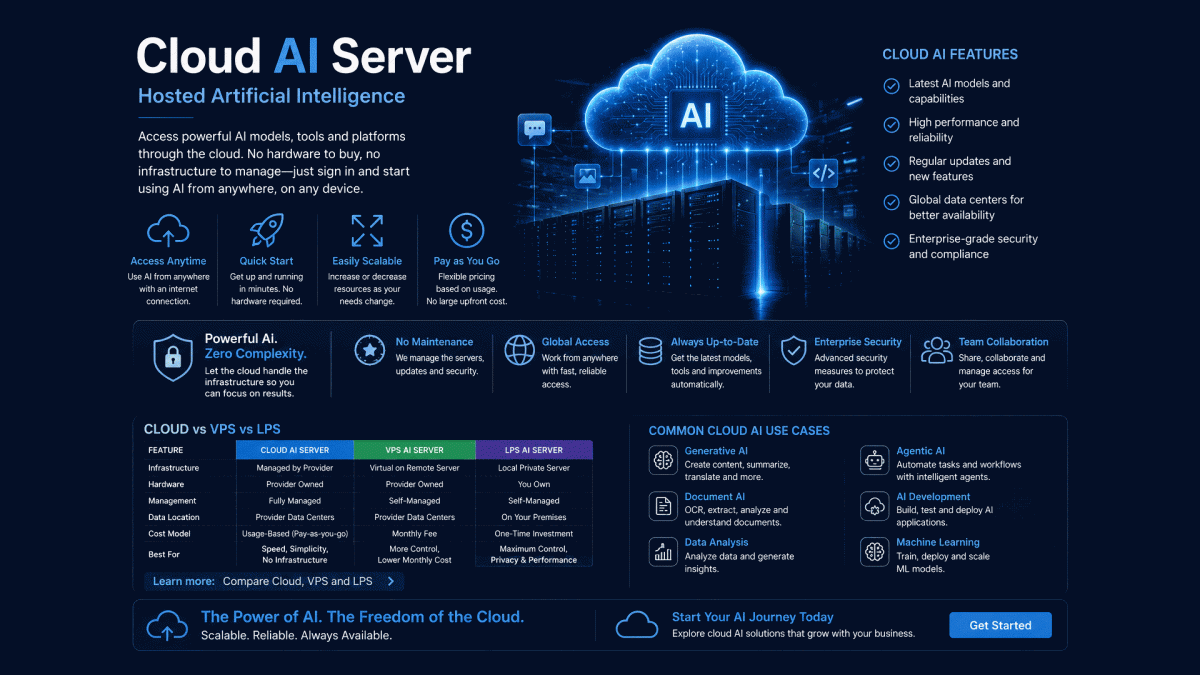
A Cloud AI Server runs artificial intelligence on infrastructure owned and managed by an outside provider. Users connect through the internet using a website, application or API instead of running the AI on their own hardware. This makes Hosted Artificial Intelligence one of the easiest ways to start using AI.
Cloud AI can provide access to powerful models without purchasing GPUs, servers or other specialized hardware. The provider manages the computing infrastructure, updates and large-scale resources, while the customer pays through subscriptions, API usage, service plans or other cloud pricing models.
The trade-off is dependence on the provider. Your organization normally relies on internet connectivity, provider availability, account authentication, pricing, usage policies and service limits. Businesses working with sensitive information should also consider where their data is processed and what information is transmitted to the cloud.
For organizations comparing different AI Deployment Models, cloud AI is only one option. A VPS provides more control over remotely hosted software, while a Local Private Server (LPS) can bring supported AI processing directly into the organization's own network.
How Does a Cloud AI Server Work?
When a user sends a prompt, document or other request to a cloud AI service, the information travels across the internet to the provider's infrastructure. The provider's servers process the request using its AI models and return the result to the user.
This means the user does not need to own or maintain the hardware running the model. The provider handles the GPUs, storage, networking and large-scale infrastructure behind the service, making cloud AI simple to access from computers, phones and business applications.
Advantages of Cloud AI
Cloud AI is convenient because there is little or no local infrastructure to install. Businesses can begin using AI quickly and gain access to models that may require far more computing power than they could reasonably purchase for a local server.
Cloud services can also scale without physically upgrading equipment at your location. If a provider offers additional capacity, models or services, customers can often access them through a different plan or API rather than replacing their own hardware.
Limitations of Hosted Artificial Intelligence
The simplicity of cloud AI comes with less infrastructure control. The provider determines the available models, service limits, authentication methods, pricing and availability. Changes made by the provider can affect how customers use the service even when their own business requirements have not changed.
Cloud processing can also involve network and response delays, service interruptions, token or usage restrictions and ongoing usage charges. These issues can become more noticeable when AI is used frequently throughout daily business operations.
Cloud AI and Data Privacy
Cloud AI normally requires information to leave the local network so it can be processed on the provider's infrastructure. For general information this may be acceptable, but businesses working with sensitive data should understand what information is transmitted, retained and processed by each service.
A Private AI approach can keep supported workloads closer to the organization. This does not mean cloud AI should never be used; many businesses can combine local processing for sensitive or frequent work with cloud AI when external models provide a clear advantage.
Cloud AI Compared With VPS and LPS
| Feature | Cloud AI | VPS AI | Local Private Server (LPS) |
|---|---|---|---|
| Infrastructure | Provider Managed | Remote Hosted | Locally Controlled |
| Initial Setup | Very Easy | Moderate | Server Setup Required |
| Hardware Purchase | Not Required | Not Required | Required |
| Internet Dependency | Required | Required | Not Required for Supported Local Workloads |
| Data Control | Provider Environment | Hosted Environment | Customer Environment |
| Hardware Control | Provider Controlled | Plan Dependent | Customer Controlled |
| Model Access | Very Large Hosted Models | Hardware / Plan Dependent | Local Hardware Dependent |
| Recurring Cost | Subscription / Usage | Monthly Hosting | No Monthly Server Rental |
| Offline AI | No | No | Yes, for Supported Local Services |
| Best For | Convenience & Large Hosted Models | Remote Hosted Applications | Private Business AI Infrastructure |
When Should You Choose Cloud AI?
Choose cloud AI when you want fast access to powerful models without purchasing AI hardware. It is especially practical for occasional use, experimentation, rapidly changing model requirements or tasks that need models too large to run efficiently on your available local hardware.
Cloud AI can also be useful when employees need access from many locations and there is no requirement for local infrastructure. For many organizations, cloud services will continue to be an important part of their overall AI strategy.
When Does Local Private AI Make More Sense?
A Local Private Server can make more sense when AI is used frequently, sensitive information is involved, fast local response matters or the organization wants more control over hardware, software and service availability.
Thinkputer can also reduce dependence on recurring AI usage fees, token restrictions and external availability for supported local workloads. The business owns or controls the infrastructure instead of renting every AI request from an outside provider.
Cloud AI and Local AI Can Work Together
Choosing a Self-Hosted AI platform does not require abandoning the cloud. Thinkputer can process suitable workloads locally while still connecting to external APIs and hosted AI services when a particular cloud model is the better tool.
This hybrid approach allows businesses to keep sensitive, frequent or latency-sensitive processing local while maintaining access to the scale and specialized capabilities available from cloud AI providers.
Cloud AI Server Frequently Asked Questions
No. A Cloud AI Server normally refers to an AI service where the provider manages the models and infrastructure. A VPS gives the customer a virtual server where supported software can be installed and managed. Compare all three approaches on our Cloud vs VPS vs LPS page.
Not necessarily. Cloud AI can be very useful for large models and specialized services. A Local Private Server provides another option for workloads where privacy, speed, availability or infrastructure control are more important. Many businesses can benefit from using both.
Cloud, Local or Both?
Tell us how your organization currently uses hosted AI, which data and applications are involved, and what limitations you are experiencing. We can help determine whether cloud AI, a VPS, a Local Private Server or a hybrid approach is the better fit.